anghraine: Uhura and Chapel kiss in the background, ignored by Spock (spock [oblivious])
I think perhaps the most purely "wait, what" fanon to me (even surpassing Kirk Drift in strangeness, though much less annoying) is this rough scenario that I've probably seen dozens of times at this point:

1. Spock and Kirk are either already together but there's some uncertainty about where they stand with each other, or it's unrequited-but-not-really pining or whatever. Regardless, Spock does something that is pretty understandably upsetting or hurtful in the context of their relationship.

2. Kirk is privately upset and vents to McCoy about [thing].

3. McCoy upbraids him for being insufficiently understanding of where Spock is, or might be, coming from and for being immature enough to sit around being upset instead of handling the communication in his relationship with Spock.

Read more... )
anghraine: uhura confidently sits at the weapons panel while kirk remains tensely in the captain's chair, both bathed in the red lighting of "balance of terror"; text: "you're the only one who can do it" (from "mirror mirror") (kirk and uhura [bridge])
J and I have re-watched three seasons of TNG, and the number of times I've felt that Troi or Crusher is 100% correct and Picard in particular is being an incurious asshole are getting... let's say, numerous. And in general, they seem to get out-shouted by the male senior officers in this "we're just being reasonable while you're being emotional" way that I find intensely annoying. Even when the plot ultimately justifies their perspective, they seem to get these vague acknowledgments in a private setting, not the unqualified public apologies they frankly deserve—because, IMO, the show itself doesn't feel they deserve them.

Meanwhile, when we marathoned TOS, I was pretty surprised by how much I ended up liking Kirk, and then I ended up loving him even more on some re-watches, despite the occasional dire writing ("Elaan of Troyius" can't make me hate him; my most beloathèd writer on TOS just decided that, in addition to writing Elaan as an unholy combination of Katharina from The Taming of the Shrew and just a racist caricature in general, Kirk was going to be Petruchio for a day and also that it'd be hot if France Nuyen roofied and had sex with him, which is, um, rape, but the episode doesn't understand its own plot the way e.g. "Wink of an Eye" or even freaking "Catspaw" understand what's wrong—and it was written by the same guy who wrote the virulently antisemitic "Patterns of Force" that goes out of its way to put Kirk and Spock in Nazi uniforms—just them among the main cast for most of the episode, for some reason, though it's unusual for them to be placed on a mission alone—and the script includes extra antisemitism directed individually at both Nimoy and Shatner on different occasions). There are a lot of reasons that TOS Kirk in particular ended up as my peak ST blorbo, even surpassing Spock's hold on my heart (though I love him deeply), but one of the reasons are scenes like these that TNG has very definitely brought back to mind:
KIRK: At least try cutting him off!
UHURA: Sir, if I could cut him off, don’t you think I—!
RILEY: ♪ I’ll take you home again, Kathleen— ♪
UHURA: Yes, sir, I’ll keep trying.
KIRK [apologetically]: Sorry.

KIRK: Yes, I’m aware of that, Mr. Scott.
CHEKOV: And, sir, the fact Earth took twelve centuries doesn’t mean they had to.
UHURA: We’ve seen different development rates on different planets.
SCOTT: And were the Klingons behind it, why didn’t they give them breechloaders?
CHEKOV: Or machine guns?
UHURA: Or old-style hand lasers?
KIRK [sharply]: I did not invite a debate. [pause] I’m sorry. I’m worried about Spock and concerned about what’s happened.

These apologies are quite simple, not emotional or dramatic or detailed at all, but that's fine. Just the acknowledgment that he was in the wrong and apologizing for it without hesitation or taking it to a face-saving private location or whatever, just saying it right there in front of everyone, is incredibly refreshing. In both of these, also, Uhura is one of the people he's responding to—it's possible that he's readier to apologize in such an open and unambiguous way because Uhura is involved and they're particularly close (their obvious and consistent mutual affection was another of the big TOS surprises!). I don't really think so (McCoy also freely apologizes on the spot multiple times, if less often than his behavior merits), but maybe Kirk's apologies are prompted by Uhura's involvement. However, if so, TOS going out of its way to show a very white-coded male hero publicly and correctly apologizing to the competent and justified Black woman who answers to him in front of his other subordinates doesn't make it any less welcome tbh.

(I'm definitely enjoying parts of TNG, but if several of the TOS movies frustrated me by moving towards 80s space explosions blockbuster when I was invested in the Having Things to Say Even if They're Deeply Flawed approach of TOS along with the visual experimentation, generally unexpected nuances of the characters, and sheer joyous camp of it all, TNG has seemed so painfully complacent 80s and essentially cautious in its fundamental perspective that I miss TOS all the more, its many faults notwithstanding.)
anghraine: kirk and spock stare at each other in a turbolift on the enterprise; their shadows projected on the wall behind them are nearly touching (kirk/spock [turbolift])
To continue my periodic Tumblr TOS!K/S fandom pet peeves: I keep periodically running into comments on gifs or meta wrt Kirk and Spock's unhinged mutual jealousy of each other's love interests (or just. interests) that go something to the effect of: "well I like a Kirk and Spock who are a healthy, open-minded poly couple who don't get jealous at all." Every time, I can't help thinking, "Okay, so you don't actually like Kirk and Spock, then."

I mean, it's possible to like most of a character and headcanon away some specific detail that you think doesn't work or is OOC in the wider context of something that long and complicated (me with "Elaan of Troyius"; forcing Taming of the Shrew onto the TOS cast is a terrible and indeed OOC idea to begin with, but it simultaneously manages to be racist towards Elaan while shrugging off her drugging the previously repulsed Kirk into sex, and unsurprisingly shares a writer with the ragingly antisemitic "Patterns of Force"). But you have to ignore such a major component of their dynamic and characterizations to deny their jealousy wrt each other that this seems like ... not an offensive misreading, really, and there are others that bother me more on that level, but few strike me as so absolutely wrong. Every time I see it, I wonder if the person has even seen the show, at least at all recently, because it's just ... it's not even that it's baseless as an interpretation, it's actively contradicted so flagrantly, so often, that it seems completely disengaged from the show.

(Kirk's heartfelt, melancholy description of love is extremely and explicitly monogamous, well beyond the casual defaults of what you'd expect from the era, and he's ... I mean, Kirk spends almost the entire show fully aware that Spock is ashamed of his feelings for him, and after the first shock, is incredibly tolerant and unconcerned about Spock dealing with this angst via repression and blatant lies. But Kirk's easy, patient assurance around this dries up the instant he gets the slightest glimmer of a suspicion that someone or something else could conceivably dislodge his position at the center of Spock's world. He seethes with extremely visible jealousy and hostility whenever that happens and swings to the opposite extreme of getting unhappy and insecure. And Spock's jealousy is even more incredibly conspicuous and persistent throughout most of the series, especially in episodes like "The City on the Edge of Forever." By S3, Spock has hit such an intensity of envy that when Bones is like "you just couldn't understand love triangles, or love at all, all the desperate things it drives people to do, the ecstasies and agonies... anyway g'night" Spock immediately responds by mind-melding with the unconscious Kirk to remove his latest love interest from his memory after bleeding jealousy of her the whole episode. Kirk and Spock are many things, but healthily poly people free from jealousy and insecurity is certainly not among them!)
anghraine: kirk stands behind an elderly man turned away from him; kirk's manner is severe and almost menacing while the old man (kodos the executioner) looks thoughtful (kirk and kodos)
The household Star Trek movie watch just hit The Wrath of Khan! I’ve seen it multiple times before, but it was really different to watch it so shortly after watching TOS and TMP.

My feelings are … more complex now. Where Spock’s character growth was randomly rewound in TMP for unexplained reasons, Wrath of Khan!Spock feels more of a projection into the future. He’s older, steadier, and less repressed, while still retaining the composure and dignity that are so personally and culturally important to him. His sense of humor is still dry but less buried and harsh, he’s reserved and unflinching in a very Spock way, but it feels healthier and more integrated than he was capable of before. I don’t get the impression that he’s at all ashamed of what he feels for Kirk at this point, nor ashamed of much at all.

I feel like we see how far Spock has come from his early shame and denial, for instance, when Kirk, McCoy, and Saavik go to beam to the research base. There’s this less-repressed-than-formerly-but-still-powerful intensity in Kirk and Spock's farewell that, as ever, gives the distinct sense that everyone else just ceased to exist for them. Spock says outright, “Be careful, Jim” and it’s very adorable and relatively open by Spock standards. And then professional hater McCoy is like … oh, so am I chopped liver? while Saavik is just ????? and it’s hilarious and just feels very recognizable.

[ETA 7/4/25: this is still roughly my opinion after re-watching the other TOS movies, with one large caveat I struggled to fully articulate at first. Both TOS and TMP emphasize that an overwhelmingly Vulcan Spock is not true to the fuller reality of who Spock is and is not psychologically healthy for him. The lifelong pressure he's been under to compress himself into someone who could fit within an acceptably Vulcan identity is the source of his suffering and (gay-coded!) repression. His arc throughout TOS, which is then repeated and finalized in TMP, was all about him finding a path out of this repressed, ashamed existence, a path in which he doesn't need to renounce the ways he's Vulcan, but can accept himself in a healthier, more balanced way than Vulcan culture or his own hang-ups were ever going to allow. The essential tension of TMP pivots on this far more than on anything to do with Kirk, and culminates in Spock refusing to return to seek approval on Vulcan, and instead staying with Kirk and going to Earth—this is symbolic, not just a plot detail. Spock has struggled to prove himself a true Vulcan, even while choosing Earth/humanity at essentially every fork in the road: joining Starfleet instead of the VSA, serving on a human Starfleet vessel instead of the Vulcan ones that exist in TOS, refusing alternative, more Vulcan-typical opportunities like with Kollos because he insists his life is on the Enterprise, breaking his kolinahr when Kirk and V'ger unintentionally reach out, and finally confirming all these decisions in that refusal to go back to Vulcan.

But the two Meyer films, The Wrath of Khan and The Undiscovered Country, are more inclined towards idealizing Spock than the other films (and certainly more than TOS), and idealizing him specifically in Vulcan terms. Both lean into this largely idealized Spock who is essentially the face of Vulcan maturity, driven by Vulcan philosophies he never mentioned and rarely adhered to previously, and don't really engage with how deeply trying to be an ideal Vulcan has been a source of pain and real harm for him, nor with his arc largely involving movement away from overriding identification with Vulcan and towards identification with his relationships to other people, especially Kirk. In both, Spock's relationship with Kirk is more ambiguous than in the other films, despite still being very important. The major exception to this "Vulcanizing" of Spock without much sense of its costs is the death scene, where the glass between Spock and Kirk gives shape to the price of his emotional distance—and honestly, it was unsurprising to discover that the idea for that came from Shatner, not Meyer. As powerful as the death scene is, Spock's side of the dialogue is rather odd to me in characterization terms, especially after TMP; the idea that he'd address Kirk as Admiral at such a moment rather than Jim, the kind of generic "don't grieve" sentiment that has little to do with any particulars of their relationship. Much of the power of the scene comes from the cinematic language and the absolutely superb performances, IMO.

But then, my fandom heresy is that I actually think The Final Frontier does a much better job than The Wrath of Khan of credibly showing a Spock who has come to terms with his hang-ups around his culture and family and feelings and relationships, and can insist on the whole person he is now, while remaining very much recognizable with Spock's distinct quirks. He's still capable of fucking up in very Spock ways and being characteristically petty and defensive about doing so, but he's also grown beyond Sybok and Sarek and proving himself as a Vulcan on a very fundamental level, without cutting out any part of what makes him who he is. Godslayer Spock > perfect Vulcan ideal Spock! In any case, though, I do feel that Meyer's Spock is pretty deeply disengaged from the basic direction of his arc in TMP and TOS and, like with Kirk, much more influenced by the pop culture perception of him than the details of his original characterization. It's not terrible but it is noticeable, and that swerve has strongly influenced the perception of Spock as a character over time, including in his original incarnation. I like seeing Spock live his best life in TWOK, to be sure, but I do think the execution is conceptually flawed.]

Read more... )
anghraine: kirk and spock stare at each other in a turbolift on the enterprise; their shadows projected on the wall behind them are nearly touching (kirk/spock [turbolift])
Technicallyyyyy it’s Thursday (12:28 AM!), but [personal profile] brynnmclean tagged me in WIP Wednesday (thank you!!!) and I dutifully worked on some other projects before giving up and following my heart.

And what my heart wanted was … well. Okay. Look, I know, I know, but nobody can be that surprised:

S’paak had no way of knowing which Starfleet officer would receive command of the Enterprise after Captain Pike’s promotion, if promotion it could be called. It must be called that, of course, by the wish of Captain Pike himself, and by what all evidence suggested was a collective agreement from the highest ranks of the service. Therefore, the captain was promoted, and soon she would answer to a different man.

She had no data to aid speculation as to the nature, character, or identity of the person who would replace Captain Pike, since nobody in the crew, including S’paak, was privy to their superiors’ deliberations. Accordingly, she did not join the other crew members in guesswork about their new captain, even in the privacy of her own quarters—or her own mind. After all, to a disciplined intellect, there was little difference between the two, and she did not know who was even under consideration. Contemplating the matter would not produce greater knowledge.

Even with no particular expectations or thoughts about the forthcoming captain of the Enterprise, she felt an unfamiliar trace of surprise when she received the actual notification about it. She, S’paak, would be first officer on the ship, and as such, had been granted priority status with regard to personnel changes. No one else on the crew yet knew the name of the chosen captain.

The privileges of seniority did not startle her. The identity of her captain did, a little.

S’paak considered the notification a second time.

Commanding officer of the USS
Enterprise: Kirk, Jessica T. (Cpt).

She knew virtually nothing of Captain Kirk, though the name sounded faintly familiar, enough that she thought it likely that she had heard it in some context in the past that had not struck her as worth committing to memory. A regrettable lapse, if easy enough to rectify with the many tools available to her. But S'paak had not expected that Starfleet would appoint a woman to Captain Pike’s position. Certainly not a young woman, as the (small and poor-quality) picture accompanying the name suggested Kirk was.

S’paak herself was not so illogical as to suppose that gender impeded a Starfleet officer’s capabilities in itself. But she had better reason than most to know that the practices of the Federation did not always resemble their ideals as closely as might be wished. Captain Kirk must have some unusual qualities, experiences, or connections—or some combination thereof—to rise so far at such an age.

“Fascinating,” S’paak murmured.

Tagged: #i would tag people but it's. uh. thursday #ALSO there is a method to the various choices made here i swear #also i am not AS hostile to post-tos sources as i am to the sweu etc but it's been years since i saw any of them #and i'm not concerned with accommodating long after the fact 'canon' material. this sparks joy (for me personally) and that is enough

[ETA 4/18/2025: After watching all the original ST movies, I feel more strongly than ever that ST is really many canons in a trenchcoat—engaging with each other but not actually compatible. This is especially the case with regard to Spock and Kirk, who take the biggest character arc hits via pop culture-ification and the soft reboot in even the original films, and only more over time (cf. the famous "Kirk Drift" article). I think movie Spock's arc is basically completely reset while defining him MUCH more by Vulcan culture throughout the films, but also swapping his and Kirk's TOS priorities pretty substantially. Kirk was often defined by The Good of the Many in TOS—few things infuriated him more than threats or harm to his crew, esp en masse—and I don't think it was TOS Spock's philosophy for a single moment. I also don't think that TOS Spock was truly all that normative as far as Vulcans are concerned; he often went out of his way to emphasize that he's half-human, his navigation of Vulcan identity was extremely fraught, and the function of that aspect of his arc was an attempt, however flawed, to engage with biracial problems specifically. So yeah, I super don't feel any need to bow to the movies or TNG or whatever, they're their own things—sometimes great, certainly engaging with TOS at times, but in an Aeneid to TOS's Iliad sort of way for me. And I do appreciate that ST historically has seemed less obsessed with welding a bunch of wildly disparate and not especially compatible projects into a single "canon."]
anghraine: t'pring from tos: she is a vulcan woman with dramatic, sparkly silver eyeshadow and dark hair in a tall, elaborate coiffure (t'pring)
I was actually slightly on edge about getting into a frankly notorious fandom without encountering this kind of thing sooner. After getting a somewhat clearer sense of trends and fun conversations and persistent annoyances (at least on Tumblr), and after monologuing my TOS feelings, I still hadn't received any particular unpleasantnesses on a personal level, and was like ... well, maybe people are nicer now, even to someone like me. But mostly I was just waiting for the other shoe to drop, especially given that I'd found TOS in particular very different from what I'd expected via fandom and pop culture osmosis on many, many levels.

But it would have never occurred to me that my controversial TOS hot take would be "Spock's co-workers are racist to him a lot and this is the main vehicle for TOS's exploration of racism as a thing." But yup, I got anon hate about how "funny" it is that I'd been complaining about bad Kirk takes (specifically, I'd recently seen a conversation about how "TOS Kirk actually doesn't experience angst over anything but challenges to his authority" when I'd been very surprised to discover that a) TOS persistently returns to how lonely and fearful of being left alone he is, and b) TOS Kirk is a genocide survivor struggling with his options of "doing nothing" or "ruthless vengeance", and he was bullied in the Academy for being "grim" (no shit?), and that's not even the only massacre he survived, and a lot of his infamous romances are blatantly coercive towards him). See, it's funny because I'm so biased towards Spock that I don't even realize it and have said people are just always being mean to him.

(I don't think I said "mean." I said racist.)

Anyway, I was so utterly baffled by that of all things being my big controversial ST opinion that I read it to my housemates for shits and giggles, though normally I keep fandom drama away from RL. Since my BFF J is a massive Trekkie and Ash has watched a few TOS episodes with us, they got the context and J was just laughing his head off while a very confused Ash was like, "Has this person seen it?"

On the bright side, we had a whole conversation about the various desperate flailing attempts I've seen to defend the general racism against Spock within the show, or at least to suggest that it's no different from Spock's or Kirk's own behavior, and that ended up being actually interesting, so at least something deeper came of it! But I'm still baffled at how you watch something like "Balance of Terror" and come away thinking the point of Spock's experiences and Kirk's outrage is "Spock gives as good as he gets, though, so it's not REALLY racism."

On top of that, J and I had actually been talking days earlier about how there seems this strange fandom embargo on engaging with, particularly, McCoy's racism in interpreting his character, its function, and especially his relationships with Spock and Kirk. Not only "I prefer to headcanon something different" but indignation over anyone anywhere even acknowledging it's part of the show. J and I are actually really interested in the ways that TOS sets up this Spock vs McCoy tension in which Kirk is either the mediator or battlefield—or the tension rises because he's not there—but this is never really a balanced tension because both Kirk and the narrative itself so obviously favor Spock over McCoy. And Kirk himself is even more favored. There's a reason that Spock gets twice McCoy's share of the overall dialogue even though McCoy is chattier. J actually has a theory that a more balanced version of the triad might have been more effective in a lot of different ways (thematically, their relationships with each other and how those reflect on their individual characters, etc), which I do find interesting to consider, but there's so much defensive dogma about how they're all totally balanced and equally important and favored that it can be difficult to figure out where these interpretations are even coming from. Just about every conversation I've seen about McCoy in any capacity, or about the bigotry directed at Spock, becomes a very strange game of Telephone very fast.
anghraine: choppy water on a misty day (sea)
If you follow me on Tumblr, you've seen me trip into an unexpected (for me) Kirk/Spock spiral. I knew, of course, that the ship is the granddaddy of modern western slash fandom—and fandom as many of us know it wouldn't exist without the ship's passionate early fandom—but given that a) ships can be wildly popular without me personally finding them compelling and b) I don't tend to be into m/m in general, I really didn't expect I would fall head over heels for it.

I think partly it's because sometimes I was watching with people who strain to ignore all hints of homoerotic subtext between anyone when it's not explicitly spelled out, and I was annoyed at the refusal to even consider any other possibility than The Holy Bond of Totally Platonic Heterosexual Dude Friendship despite the truly copious amount of material in this case. But even apart from that, I went from being a bit surprised the foundational slash fandom juggernaut wasn't "more or less typical bromance filtered through fandom goggles" but actually the real super homoerotic deal to "losing my mind about this" due to some particular, uh, incidents in TOS. The final straw for me was actually the season 3 episode "Requiem for Methuselah" (in which Kirk has a decidedly mediocre het romance Spock visibly dislikes, leading to a final scene in which McCoy claims Spock can't understand love triangles or the victories or agonies of love that Kirk has experienced, and without so much as a scene break Spock just waits for McCoy to leave and then wipes his rival from Kirk's memory. unhinged gay shit is what I needed to truly succumb, I guess!). But there were also three major S1 episodes that heavily contributed to my eventual "AHHHHHH MY SHIPPP" downfall. These weren't the only wildly shippy moments in the season (hahahahahaha), just the ones that were the emotional equivalent of being punched in the stomach:

1) "The Naked Time": I love this episode for many reasons, not only K/S ones (in fact, more for Spock feelings in general). However. This is the episode where everyone gets space drunk and loses all their inhibitions, so they just start doing whatever their repressed instincts and fantasies and emotions drive them towards (the fantastic "I'll rescue you, fair maiden!" -> "Sorry, neither" Sulu-Uhura scene happens in that context). Most people are just kind of silly. However, there's a point where Nurse Chapel passionately declares her feelings for Spock, and he gently rejects her but is deeply upset about it. The next time we see inhibition-free Spock, he's jumped from feeling terrible about Chapel to feeling terrible about his mother's emotional isolation on Vulcan, and his own participation in it. Kirk tries to shake him out of it, and an increasingly anxious Spock confesses, "Jim, when I feel friendship for you, I'm ashamed." Kirk keeps trying to shake him back to his senses and he just says in agony, "Understand, Jim. I've spent a whole lifetime learning to hide my feelings..."

I will say that normally, I am not one of the lesbians who finds much catharsis in m/m or mediates my own feelings about my own marginalized sexuality through it (my main exception to this was Faramir/Aragorn as a teenager). But Spock's "in vino veritas" being not daring escapades or wish-fulfillment fantasies, but misery and shame over both his feelings and his detachment (in the fourth-aired episode of the nearly 80 episodes of the series), and also shame over his lifelong attempts to conceal what, and how much, he truly feels just hit so hard. The fact that we later discover that his cultural norms led to him getting railroaded into a het marriage as a literal child and that he clearly loathes the necessity of sex with his wife only intensifies the sense of déja vu I started getting. Who knew that watching subtextual pining from a science-fiction show aired in 1966 could tear off the scabs on my "lesbian raised Mormon" damage? Not me until this episode!

[ETA: I know some of you are SNW fans, so note that I'm pretty harsh about it under the cut.]

Read more... )
anghraine: the standard art of female commander shepard from mass effect (an armored soldier with red hair and pale skin) (shepard)
I've been watching the reactions to DA:V in some fascination as someone who has never played any Dragon Age and only understands them in the vaguest way possible. I know the usual Bioware fandom warfare is particularly vicious there (I heard people referring to more batshit BG3 wank as blatantly imported from DA wank rather than usual D&D or Larian discourse, which seemed very credible). I know it's fantasy, with some Mass Effect-y elements mechanically, and... elves are oppressed I think maybe and there is slavery? possibly?? I heard Veilguard is unusually conflict averse for DA and that it traditionally leaned into the main characters being difficulty, messy people with genuine clashes (I don't know if this is true). I also know that qunari are the horned people that produced nonbinary icon Taash and I know some of the character names/designs from earlier games, but without knowing which particular game they come from or what any of their backstories are.

(I am not asserting any of this with confidence, just to be clear. It's what I've osmosed without researching anything at all.)

ANYWAY while seeing the DA:V discourses flying around, I'm busy on Tumblr having my own wanky Bioware opinions, but for ME1 (which came out nearly 20 years ago and which I've seen all the way through nearly three times) despite typically having a strong preference for fantasy over sci-fi. And I do love ME (the trilogy) a ton, so I'm just more into it fannishly than a lot of games, despite my many points of criticism (let's just say that my bff J and I once had a very fun two hour-long car ride in which we spent the whole time discussing how we'd fix the trilogy). So my Bioware fandom friends are having wildly varying strong opinions about DA that I barely understand, and I'm banging my drums in 2025 about how, uh, the Thorian did nothing wrong. Also, the volus are unfortunately an antisemitic stereotype, even though I like them as characters a lot and feel their complaints are justified (J succinctly summed up our mutual position: "could be worse, could be Watto, but they are very obviously stereotypes about Jews in space"). And I'm Team Vorcha (vs Literally Everyone).

It takes all kinds is all I'm saying. And I'm one of those kinds!
anghraine: a female half-elf with shoulder length hair in 3/4 profile (larissa (unimpressed))
Hey all. :\

I have a post on Tumblr about it that I imagine most of you have already seen. The short version would be that this doesn't feel as bad as Trump's first victory did—I had told myself over and over that this could happen, that it would come down to political trends thousands of miles away from where I live, etc. But my brain is telling me it's actually much worse. Trump scraped a victory in 2016 with a deck stacked very heavily in his favor, and without certainty about what his administration would really look like given that he's a lying blowhard, via the electoral college but against the will of the greater number of voters. That didn't mean he wasn't president, but getting fucked over by outdated mechanics of government set up by long-dead men is not the same as getting fucked over by fellow citizens who are very much alive and who know, or have the ability to easily find out, about the policies of the first Trump administration. Kamala Harris, whatever her faults, did not have anything like the baggage of HRC and yet the people of this country were far more willing to vote for Trump against her.

I've been quietly enraged for hours in a way I don't often get—I get annoyed, and sometimes I get normal angry, but like ... in 2016 I broke down crying over and over, and I haven't done anything of that. I feel cold but not numb. The last time I felt this kind of frozen hatred was when a relative told me he'd struck a plea bargain about statutory rape with a sixteen-year-old student and was telling me so I didn't find out about it in the news. I didn't get upset as such, or feel immediately angry, or fight with him about it. I simply didn't care whether he lived or died for years afterwards.

There's this awful review of The Borgias that condemns Jeremy Irons's performance as Alexander VI/Rodrigo Borgia, because the reviewer claimed Irons lacks the appropriate "fire" to play Rodrigo—he admits that Irons does play him with a kind of fire, but says that Irons "burns with the steely flame of the North, not Latin fire." I thought this was a hilarious and very stupid characterization of both Alexander VI and Jeremy Irons, and told my best friend J about it, and it's entered our friendship lexicon. But he (my bff) has remarked a couple times that when I get truly, genuinely angry, it is absolutely a Steely Flame of the North situation. And I'm definitely feeling that now—not numb, not sad, not shocked, not screaming, just kind of hard.

I will say that, despite dutifully voting for him in the primaries, Bernie's "this is happening because of the Democrats turning their backs on working-class people, they lost the white ones to Trump and now they're deservingly losing Latino and Black ones" shtick is even more contemptible than usual IMO. Yeah, he's hammering it into his The Class War Is The Only War constant replay loop, but I don't know why the fuck he's associating this with Black voters. From what data we have at this point, the talk about Black men switching from Biden to Trump came out to a shift of four points from 2020 in exit polls (which, while done carefully, are known to be rough estimates—that's in the realm of statistical noise) and even if you did treat them as 100% accurate, the exit polls have Black female support for Trump actually dropping three points from 2020. (Union households favored Harris, btw.) Maybe he referenced Black voters to avoid sounding like he's scapegoating Latine voters specifically (who did shift towards Trump, especially men), maybe he's talking about lower turnout, but I think it's honestly super shitty to associate Black voters with this loss when a) there are many other more proximate causes, b) many Black voters are deliberately disenfranchised by their state governments and deal with more obstacles to voting than virtually any other group, and c) Black voters have been and remain unambiguously the most stalwart Democratic demographic apart from LGBT people (iirc the only group even slightly close is Jewish people—the same exit polls have them at 78% Democratic to Black voters' 85%, with Black women specifically at 91% for Harris). Lumping Black voters in with almost anyone else flattens a truly vast divide.

Huh

Aug. 13th, 2024 07:32 am
anghraine: vader extending his lightsaber; text: and now for the airing of grievances! (Default)
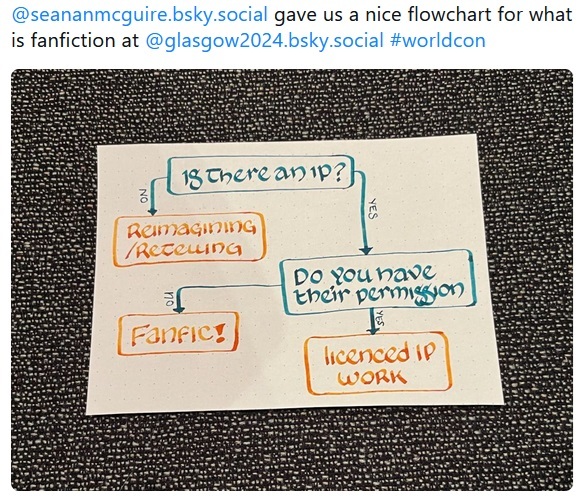
I don't even recall who posted this, but apparently at Worldcon, Seanan McGuire presented this simple flowchart to explain what is and is not fanfic:


I have no grievance with McGuire in general, but this is both elegant and quite wrong, IMO. Sorry, my Austen fanfic is very much fanfic (and there's no need to give the P&P "variations" industry any more delusions of grandeur than it already has, lol—those are very much fanfic, too). Some of my fics could also be considered re-imaginings or retellings—First Impressions is the obvious example as a deliberate retelling of P&P with genderswapped leads, rather than a true what-if AU—but they are absolutely fanfic. They're fiction written as a form of fan expression.

Sometimes there is a real sense of difference between fiction of this kind, especially when written in a fandom context that is clearly informed by or in dialogue with other fanworks, wider trends in the fandom or in online fandom in general, etc vs some literary re-imaginings that interrogate the source material but are not really fannish (not even in a fan hatred way). So it's not that I think all fiction of this kind should be defined as fanfic. I think that has to do with the conditions of creation rather than the novelty of the cast, setting, and/or plot. But the defining artistic criteria of fanfic as a form or genre are not determined by externally imposed legal codes or the opinion of the source material's author.

There have been many attempts to develop an authoritative definition for fanfic that ultimately comes down to "can you legally make money off it?" But that is not what fanfic is, and I'm deeply skeptical of conceptualizing genre, any genre, based on whether or when it can be sold. A lot of licensed IP writers seem very invested in distinguishing their work from fanfic—sometimes claiming it's not about superiority (sure, Jan), but it's just very important to them that they not be perceived as fanfic writers. But I'd argue that what makes licensed work fanfic or not isn't actually the license, or it being a professional job for money, but the approach of the work in question. Some IP writers are very much fans and clearly approached the licensed work as a chance to write fanfic about some part of canon they're super into with authorization from a parent company or something (various Star Trek writers seem to be very much of this type, say). Others don't really seem to be approaching their work as a form of fan expression, which is not morally wrong in any way, but definitely different. Going back to P&P, there are some takes that I wouldn't really consider fanfic (unlike the variation industry), just because the authors don't seem to be writing as fans but for some other goal. So you sometimes get P&P sequels that are really different from the fanfic—more literary in some ways, but often less engaged with Pride and Prejudice or its adaptations than the fanfic tends to be and prone to little canon errors that fans don't usually make. It's a little hard to describe but you can usually tell.

In any case: some licensed IP work is fanfic and acknowledged as such by the authors, while some isn't; some fanfic is based on source material that is long out of copyright (and some other things based on the same or similar sources isn't fanfic), and the time since publication does not merit a specific respectable distinction from, idk, normie fanfic by Marvel slash superfans or whoever is the fannish target du jour.
anghraine: padmé, coloured sepia; text: indistinct calligraphy (padmé [sepia])
I've never been the audience for "humorous headcanons that don't quite make sense as part of the joke", and I know that my sense of humor is even more muted than usual because of RL stresses. But even before that, I've been put off by this increasingly common genre of fandom joke post that's like ... "I don't remember/know the canon and I'm not going to check but wouldn't it be hilarious if [thing contradicted by about seven different elements of the story]" that then becomes some inescapably viral fanon. Sometimes the OPs don't acknowledge being unfamiliar with the story (though often they do!), but it's usually fairly clear regardless, and the OPs tend to be aggressively indifferent to the story they're ostensibly talking about. They're not so much in the fandom for that thing as in social media fandom, and it feels like the snarky, joking aspect of these headcanons is partly there to justify neither knowing or caring about the story they're talking about.

Additionally, it seems likes there's really no way to interact with this approach that isn't "yep, hilarious, this is canon to me now" or pedantic nitpicking. I don't even add the pedantic nitpicking in most of these, but some fandoms are more prone to it, and when the OP of this kind of post acknowledges the responses at all, it'll generally be with some tongue-in-cheek "explanation" of why their headcanon actually does work that makes no more sense in terms of the story, but which is presumably funny, and forceful enough to be convincing if you're not particularly into the fandom. Some of them, in fairness, will admit that they simply forgot or don't know the story that well and just thought it'd be funny, or "I choose to reject X because my headcanon is funnier, but I know it's there." But more often, I see half-mocking "actually I'm right [but you're a humorless asshole if you actually engage in any way other than agreement]" defenses.

Of course, nobody appointed me god empress of fandom or anything. There's nothing wrong per se with people making posts without being obsessively into the original material or enjoying fandom in a way I don't. But that form of defensive humor really does not work for me. And there's something about an approach to fandom that's dominated by snide, viral BNF humor that doesn't need to make any sense in terms of what it's ostensibly about, that doesn't even need its audience or author to know what it's about beyond the vaguest pop culture osmosis/online memes and is better if they don't, that I find both obnoxious and just kind of ... sad, I guess? I didn't come into fandom in the truly early days, but it was early enough that everyone I encountered had intense feelings about some aspect of the thing they personally had read or seen or heard. Even people with incredibly bad takes seemed to generally be an emotionally invested fan or hater of the actual story.


anghraine: vader extending his lightsaber; text: and now for the airing of grievances! (Default)
No doubt this merely reflects my own bourgeois morality or whatever the fuck, but I have absolutely zero tolerance for every single post that's like "the only problem with AI is capitalism and you're all just Luddites about it, the measurable environmental harm is NBD, and also data scraping from people without permission, acknowledgment, or recompense is fine actually."

They keep trying to obscure their basic argument that scraping art without credit of any kind to the artists is totally cool by plastering it over with Marx quotes and a lot of buzzwords about communism, neoliberalism, corporations, etc. But let's be real: this is bullshit sophistry. Data scraping without informing the people whose data is used, much less gaining their consent, much less recompensing them in any way at all, much less enough to compensate for this process's profound disrespect for their skills and professions, is unethical. It would be unethical in a communist utopia and it is worse in reality. AI is not bad in any and all cases, but the ways it is being trained and used are wrong, and extremely so, and the environmental harm is both significant and intrusive, which is also bad.

Yes, people are prone to jumping to extreme hyperbole about it, or believing said hyperbole, because of the Internet's usual habits and because various forms of "AI" are being imposed on people in a particularly obnoxious way and because the data scraping is genuinely super shitty and because being forced into extremely reluctant complicity with something that harms the noticeably worsening world around us is deeply frustrating. But the AI techbros' practices really are unethical and the idea that you can rationalize and deconstruct and obfuscate this to the point where every moral failing in the world is either a) a problem entirely reducible to capitalism or b) not a problem is beyond absurd, and in some ways, beyond contemptible.
anghraine: vader extending his lightsaber; text: and now for the airing of grievances! (Default)
For context: my best friend J is an ultra-ultra-dedicated Star Trek fan. I saw re-runs as a kid and had a lot of lingering goodwill towards TNG in particular, but not especially clear memories apart from First Contact (J and I had a beloved English teacher in high school who assigned it to our class :D). I haven't watched much of the newer stuff, even. I saw two JJ Abrams films (the first seemed a perfectly fine film if slightly vacuous—it felt rather more like SW than ST in some ways, but not enough to be fully satisfying as either, while the sequel sucked in a "we should have seen TROS coming" way). I haven't seen any Discovery, Prodigy, Lower Decks, or Picard episodes, just two episodes of SNW that were okay, but not really my thing. They're polished, but struck me as rather unambitious in a ST context. That said, J really, really loves other ST (he considers it basically his religion, despite decidedly rough patches such as Picard) and I hadn't seen any of the older stuff in ages, so I was thinking vaguely of catching up with some old school ST.

Meanwhile, we were negotiating our next Media Experience awhile back, and he really wants me to watch Andor. In part, this is so we can talk about it, and in part because he genuinely thinks I'd like it apart from his admission that it handles Cassian oddly given his characterization in Rogue One, but he thinks I could overlook this in the face of the show's greatness. (He does not do social media and does not fully grasp the extent of my Rogue One!Cassian stanning.) We were talking it over and I was trying to evade committing myself to watching Andor and was suddenly struck by a burst of Machiavellian genius.

him: I think you really would love it if you'd give it a chance.
me: I have a counter-proposal, since the last thing we watched was also your idea.
him: ...yeah? A different Star Wars?
me: No. Star Trek.
him: ...
him: ...
him: O_O
him: ...like, Discovery or...?
me: No. I've been meaning to catch up with the older shows, since I don't remember them very well, except bits of The Next Generation.
him: Wow. Okay. Um, well, which one ... it can't be Deep Space Nine because we're watching that later in the summer, and Voyager is, well, I love it, but like a three-legged dog. I can't really recommend starting there. But we could watch some highlights of TNG...
me: I wasn't really thinking of a highlights reel experience...
him: O_O
him: I guess we could actually start with the original series, though there are some complications with the early episodes and multiple pilots and everything, and, well, sometimes it's extremely 60s...
me: Okay, let's see!

So while this originated in a cunning plot to evade Andor by throwing in all of Star Trek in front of him like a red flag in front of a bull, I didn't want to only be using his favorite thing as a delaying tactic, obviously. I definitely wanted to give ST a fair shot and think about it and try to engage properly, etc.

I don't always have time for it, but so far we've watched the following episodes (in this order):

Read more... )
anghraine: a close-up of a man with black eyebrows and grey eyes (dúnadan)
My icon has grey eyes and black hair just for Tolkien :P

So. I generally dislike Tolkien fandom's "canonicity discourse" (yes, I'm doing it anyway) and the idea of imposing a specific ranking of texts. That said, it's occurred to me that one of the reasons I feel deeply out of step with Tolkien fandom is that The Silmarillion (as in, the published book, not the in-story accounts) is on a drastically different level of canonicity for me than basically everything else with JRR Tolkien's name on it.

I don't dislike The Silmarillion or anything. I quite enjoy it! But for me, it shows its age—not in ~a man of his time~ sense, but in an editorial sense. Christopher Tolkien did an enormous amount of spectacular editorial work over the course of his life and we are deeply indebted to him. But I think he did pretty clearly get better at it over time, and particularly at presenting his father's mass of notes and documents and so on in a way that makes the texts as accessible as possible. At the same time, in later texts, he clearly differentiates between actual words JRRT wrote (whether in the main body or in notes) and his (CT's) own understanding and explanations as JRRT's confidant and literary heir. I do give a lot of credence to Christopher Tolkien's understanding of his father's work, actually, and I deeply respect (and am grateful for) CT's efforts to carefully and clearly explain things like dates of composition (and how this can be determined), direct context, how a given point relates to his father's broader work, etc, throughout these texts.

(Tangent: Facebook keeps recommending defensive Jackson stans griping about how Christopher Tolkien just didn't get his father's work like Jackson did and was so horribly ungrateful to the filmmakers and such an inferior scholar blahblah for the crime of disliking the films. FLAMES ON THE SIDE OF MY FACE!! I am not uncritical of Christopher Tolkien, and neither was Christopher Tolkien, but I think we owe an immeasurable debt of gratitude to him. Also, even to me, his response to the films seemed harsh at the time, but at this point, I think he was pretty much right, anyway, and correctly judged the films' impact and reflection of pop culture understanding of JRRT's work.)

So what is my issue with the published Silmarillion?

Read more... )
anghraine: various thickly-bound books on the shelves of a library (library)
I was reading an article on one of the medications I take for bipolar II, in relation to its use in managing both bipolar I and II. And it was really interesting in a lot of ways, but one of the things it talked about is how scholars have often focused on mania, but the research is pretty clear that bipolar depression is much more dominant with both bipolar I and bipolar II and frequently more disruptive.

And, honestly, that is definitely my experience? It’s not to say that hypomania hasn’t been super disruptive (it starts out great! so much energy! but then my thoughts just skitter around and I can’t focus on anything, and I start getting really aggressive). But one of the most alarming things about it is that, once I realize what’s going on, I know the “high” is going to crash into depression at some point, and that lasts much longer and is more ruinous. And that mix of the high and the looming dread of depression is … weird.

I mean, my experience is that people definitely take mania (even hypomania) more seriously, so it was interesting and kind of validating to read that, yup, bipolar depression is Really That Bad for most bipolar people.

(I think, also, that the prioritization of mania/hypomania and kind of dismissive attitude towards bipolar depression is bad for people with unipolar/major depression as well. IMO the root is “depression isn’t that big of a deal, but mania is freaky,” and if your operating assumption is that depression is nbd, that can easily extend to major depression. And as someone who was misdiagnosed w/ major depression for a long time, I did run into that often enough.)

Tagged: #my deeper-yet suspicion is that there's a prioritization of what is most disruptive for /other/ people in a lot of research #much more than the actual patients #this article also got into how the assumption has often been that bipolar people's lives are mostly split between mania/depression/normal #but it increasingly seems that the bulk of our lives are depressive (mainly) and manic (sometimes) #w/ comparatively brief non-cycling periods #which strongly affects quality of life /for bipolar people/ #so
anghraine: adora as she-ra holding an unconscious catra in her arms (catradora (save the cat))
She-Ra meets rambling (very rambling) personal/family angst:

So, I’ve mentioned that She-Ra was one of my first fandoms, for a loose value of “fandom.” I was too young for the original show itself (it came out a year before I was born), but my aunt wasn’t, and she gave me all her She-Ra books and figurines, which were the only superhero-ish things I ever loved. And I loved them with my entire five-year-old soul!

In fact, I loved them for several years afterwards, and only reluctantly surrendered the books/figurines when my aunt asked if I still had them. I wasn’t really ever a “now I’m Mature and the things I used to like are Cringy and Bad” person, so I retained a strong affection even when I was older and enjoying more advanced things.

As did my aunt, who is only five and a half years older than I am. She was like my cool older sister for a long time, even though we were very different people, and I vaguely associated this relationship with She-Ra in my head. Regardless, we played together, we shared clothes and toys, she taught me how to ride horses, etc, until we drifted apart.

That happened partly because five years was actually vast at certain ages, partly because my parents moved, but mostly because of our enormous differences in personality and interests. Still, I continued to think of her as Cool Big Sis until various things happened that led to her becoming much more insular and conservative, even for a pretty conservative family (my centrist parents are radical leftists by their standards).

The Bush administration kicked off around the time I started high school, and by the time I graduated, I was determined not to ever vote for any Republican for the rest of my life (I enthusiastically voted for Kerry in my first election and was baffled that so many people I knew hadn’t bothered or, worse, actually voted for Bush out of ~patriotism). End result: I’ve been a firm and reliable Democratic voter for sixteen years, while my aunt gets more far-right every year (…and day, it feels like).

And it’s like … she long ago ceased to be “cool” given that she’s become a raging bigot (by nearly all accounts more than she ever was before, so not just something I missed because I was a kid). She dismisses the racism my father experiences when she's not personally perpetuating it, she’s ~so much for the tolerant left~ about her homophobia (and I’m lesbian), she’s awful and goes off on these asinine screeds to my mother every. single. day. Like, she earnestly argued the other day that Kate Brown is an agent of Satan.

Meanwhile, back when the new She-Ra was about to come out, she heard about it and excitedly forwarded me the link. Whatever else our differences, it’s our thing!

Read more... )
anghraine: a close-up of a female half-elf glancing doubtfully to the side (shadowheart (side-eye))
I’m so tired of posts about how the OP never liked the thing made by [creator who turned out to be an awful person], they always knew it was mediocre, and now, aha, vindication.

This isn’t just about JKR, for the record; the specific instance that set it off was about someone else, though of course I’ve seen it with HP.

It redirects the conversation onto the quality of the creation, and the quality does not matter.

The person is awful regardless of whether they’re good at [thing]. The conversation around that doesn’t need to devolve into arguments about whether [thing] actually is good or not, which is at best a distraction. Going on about your good judgment isn’t helping people, it’s just patting yourself on the back and often sneering at those who didn’t have your ~vision, including less visionary people who are among the terrible person’s targets. That is, I hope obviously, a shitty thing to do!

And it also very frequently implies that people’s awfulness—bigotry, abusiveness, whatever—is going to be apparent in their art or their outwards conduct. Often this isn’t true and leads to such obviously bad faith scrutinizing of their work that it weakens the actual, real objections to them as a person. Terrible people are very, very often perfectly upstanding outwardly and, when artists, creators of high quality work. There is absolutely no need to make it about how right-thinking people will know there’s something off about the person in question, or just dislike them before the revelation. Plenty of right-thinking people won’t know and have no clear reason to dislike them!

Just. It’s not about you and how right you were and scolding the less prophetic. It’s about the terribleness of the person and the cultural strains they’re participating in and the harm done.

/grump

May. 13th, 2024 10:47 am
anghraine: darcy and elizabeth after the second proposal in the 1979 p&p (darcy and elizabeth [proposal])
I've got a lot of P&P hills to die on, but two ideas I will absolutely reject to the end of time:

1. Darcy or Elizabeth has a redemption arc.

Character growth is not redemption. Even while depicting their parallel character arcs, Austen emphasizes the extent to which they remain essentially the same people in terms of their basic flaws (e.g. Elizabeth's continued misjudgments via reductive schemas, Darcy's cold standoffishness upon his return to Hertfordshire), but also that they were always unusually good people despite their fuck-ups and overall arcs of improvement.

2. Darcy/Elizabeth is enemies to lovers.

There's a window of time when Elizabeth genuinely hates Darcy, though even then I don't think she regards him as her enemy. Darcy does not ever hate her or regard her as an enemy, he just initially doesn't like her or find her attractive. One-sided veiled hostility towards a social acquaintance is not enemies to lovers material, sorry.

Ugh

May. 12th, 2024 07:09 pm
anghraine: vader extending his lightsaber; text: and now for the airing of grievances! (Default)
Apart from outright bigotry and viciousness, there are few Tumblr trends I find more annoying than tagging anything related to social justice as #compassion fatigue. I don't know how widespread it is, but it's happened enough on my posts (even fandom posts that only vaguely touch on actual social justice) from enough different people that it doesn't seem like a fluke.

And I haaaaate it. That is not what "compassion fatigue" is about and characterizing any allusion to the existence of societal inequality as a matter of compassion fatigue is incredibly gross, IMO. Most people who have used the tag on reblogs of my posts do it when reblogging posts about autism specifically, though the most recent was completely unrelated to that, and it's approaching auto-block territory.

D:
anghraine: vader extending his lightsaber; text: and now for the airing of grievances! (Default)
YouTube keeps reccing “what your favorite [X Fandom] ship says about you” videos, and it’s like … without additional information, your ship says nothing about you! Yes, even if it’s [Ship Someone Really Hates]. Other people don’t know your life and motivations, and it’s patently obvious that people ship the same things for different reasons. It’s how you ship it + other behavior that reveals something of yourself—and even that is easy for strangers to lump into an undifferentiated mass.

I’m completely immovable on this point, so why I keep getting these videos is a mystery.

#i mean #at least the recs evolved from 'racist and misogynistic takes on tolkien' and 'dudebros whining about star wars' #to just inane shit #(okay and she-ra fanvids) #(but that is not a mystery lol)

[ETA 5/9/2024: this has completely disappeared from the algorithm over the last couple of years, which I find mildly interesting as a phenomenon! People asked if I was thinking of one specific YouTuber and I wasn't, I just kept getting recced this kind of thing.]

Profile

anghraine: vader extending his lightsaber; text: and now for the airing of grievances! (Default)
Anghraine

January 2026

S M T W T F S
     123
45678910
11121314151617
18192021222324
25262728293031

Syndicate

RSS Atom

Most Popular Tags

Style Credit

Expand Cut Tags

No cut tags
Page generated Jan. 3rd, 2026 09:01 pm
Powered by Dreamwidth Studios